
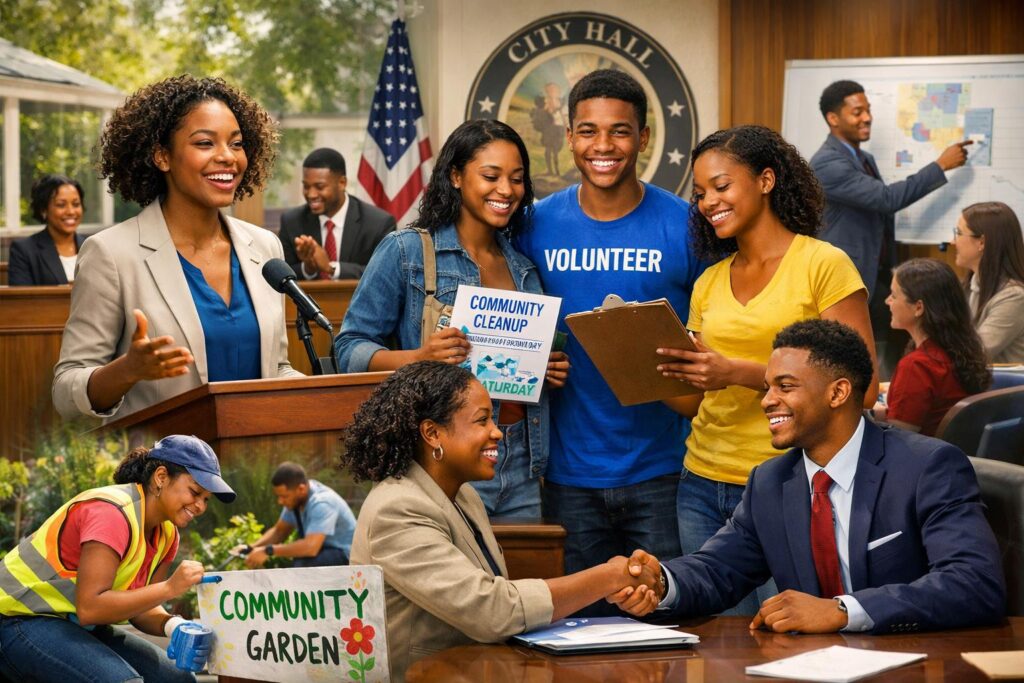
Young people are not just future leaders. They are leaders in the present. The question is whether we are investing in them as if we believe that.
As my first guide, my mother, Geraldine White, believed this and lived it. Her guiding principle was simple: work as one for community-wide goals, rather than selfish pursuits. She showed by example that public service is learned at home and lived out in the community.
During my early years in New Haven, Connecticut, my mother was a young adult balancing her work as a school nurse in New Haven’s public schools with an established commitment to community service. My father also served the City of New Haven, making public service central to our household.
At a time when community leadership demanded independence, integrity, and commitment, my mother headed Concerned Citizens for a Responsive Government, a civic organization. In the 1980s, political, social and religious differences did not divide the work. Instead, citizens collaborated to pursue shared goals over individual recognition.
My mother built that same unity, uniting people and institutions around a common agenda to increase employment opportunities, improve public housing conditions, reduce crime and advance the school system. Her collaborative leadership taught me how government and community can function together as a force for fairness, accountability, and progress.
This early exposure paved the way for my service-oriented path, brick by brick. It solidified my lifelong belief that investing in young people is not optional but essential. Engaging in community activities, participating in student government and collaborating to support youth in underserved communities became a core part of my own personal ethos.
Youth Engagement: Rooted in Purpose
Getting and keeping young people engaged in civic issues to improve the quality of education, housing, health care, and other services is imperative to influencing change. For them, seeing the direct link between their participation in decision-making and outcomes at the community level motivates them to engage. Experience has also taught me that this exposure can show young people that leadership is about responsibility and accountability, not status or ego.
I am a living testimony of how civic participation is strengthened across generations, but I have also seen this pattern of service passing from one generation to the next elsewhere. Two college friends who have sustained decades of policy advocacy and direct community investment both credit their parents and their faith for that path, as does Malcolm Crawford.
The son of Rev. John “Big John” Crawford, a prominent Chicago civil rights activist in the 1960s, Malcolm initially had no interest in community organizing. He recalls being dragged to meetings as a kid, bored, wishing he were anywhere else. Over time, this reluctance gave way to attention. Soon, he was doing the work alongside his father. The lesson he drew from that experience has guided him since: to lead, you must first be willing to serve.
Today, Malcolm leads the redevelopment of Chicago’s Austin Community through the Soul City Business Corridor, a cultural and economic enclave celebrating African American businesses, arts, entertainment and food. What he once viewed as his father’s imposition became his life’s mission.
The impact of youth engagement extends far beyond families and communities in the U.S. As a U.S. Senior Foreign Service Officer, I supported youth leadership initiatives across Africa, the Middle East, Asia and the Caribbean, each time making the same observation. I met countless young people creating and translating research, projects, or tools into low-cost tangible solutions to expansive community problems.
An example is the Youth ALLIES program in Guyana, which demonstrated the power of exposing young people to leadership skills, confidence-building, civic knowledge, and their roles as active citizens. A young Indigenous visually impaired woman, Rosemarie, described how she initially lacked confidence to lead and faced consistent barriers to education and training opportunities.
With support from the Guyana Council of Persons with Disabilities and the Youth ALLIES program, Rosemarie found her voice. She successfully advocated with local government officials for safer community infrastructure, including improvements to a bridge that she previously feared crossing. She now crosses the renovated bridge independently, and her example has moved others to act on other issues as well.
A Return on Community Investment
The return on investing in youth is not theoretical. It is measurable. When young people are given real platforms in governance, they do not wait to lead. They act. I witnessed this firsthand in Saint Lucia through the National Youth Parliament.
Through debate and advocacy around landmark child justice legislation, young people helped influence more child-centered, rights-based legal frameworks. That effort not only strengthened the legislation but also cultivated informed, confident leaders who understood how institutions function and how change is achieved.
Investing in youth as public servants and community leaders yields long-term returns. Youth engagement advances fairness, transparency, and accountability while preparing the next generation to steward public institutions responsibly.
Returning to New Haven
For the past three years, I have brought this work home. With colleagues, I have led annual leadership sessions for high school students at Career High School in New Haven. My aunt, one of the original Freedom Riders, once taught there, and my own ninth-grade teacher leads these sessions alongside me. The continuity is not just symbolic — it is intentional.
The message we bring to these students is the same one I am making here: youth are not the future—they are needed now. The issues shaping neighborhoods are the same issues shaping cities and nations. Young people’s perspectives are not supplementary to effective policy; they are essential to it.
The results reflect that. A number of these students formed community groups that are still active today, carrying their civic engagement into college and beyond. That is the return.
This work has inspired me to develop a new youth leadership program set to launch later this year, focusing on building leadership capacity, global awareness, and entrepreneurial skills rooted in creativity and culture. It is the next chapter in an investment my mother made, and one I intend to keep making.
Investing in 22nd-Century Leadership
From New Haven to Guyana to Saint Lucia to Chicago, the pattern holds. When young people are given real platforms, support, and responsibility, they contribute to real outcomes. We see the return in stronger institutions, more effective public policy, increased civic trust and more resilient local economies.
But that return requires intentional investment. Local governments, foundations, schools and community organizations must actively recruit young people into public service, invest in their development and sustain that support over time. When they do, future leaders are oriented to service and develop a lasting commitment to collaborating for the public good.
Public service extends well beyond formal institutions. When young people move fluidly between schools and community organizations—bridging government, education, and neighborhood leadership—they align around shared priorities and break down the silos that undermine community progress. This kind of cross-sector engagement strengthens the foundation for more responsive and resilient communities.
The private sector has a role too. Through partnerships with nonprofits and community organizations, businesses can help design, resource, and scale youth-focused initiatives, bringing financial investment and practical expertise to programs that deliver measurable impact.
Cross-border collaboration extends that further, sharing best practices and building global youth leadership pipelines that reflect the interconnected challenges young people face. In an era where digital literacy increasingly shapes civic participation and economic opportunity, that preparation is foundational.
Ultimately, none of this works in isolation. To build the communities and institutions we need, we must center the principle my mother embodied and that every example in this article illustrates: work as one for community-wide goals, not selfish pursuits.